
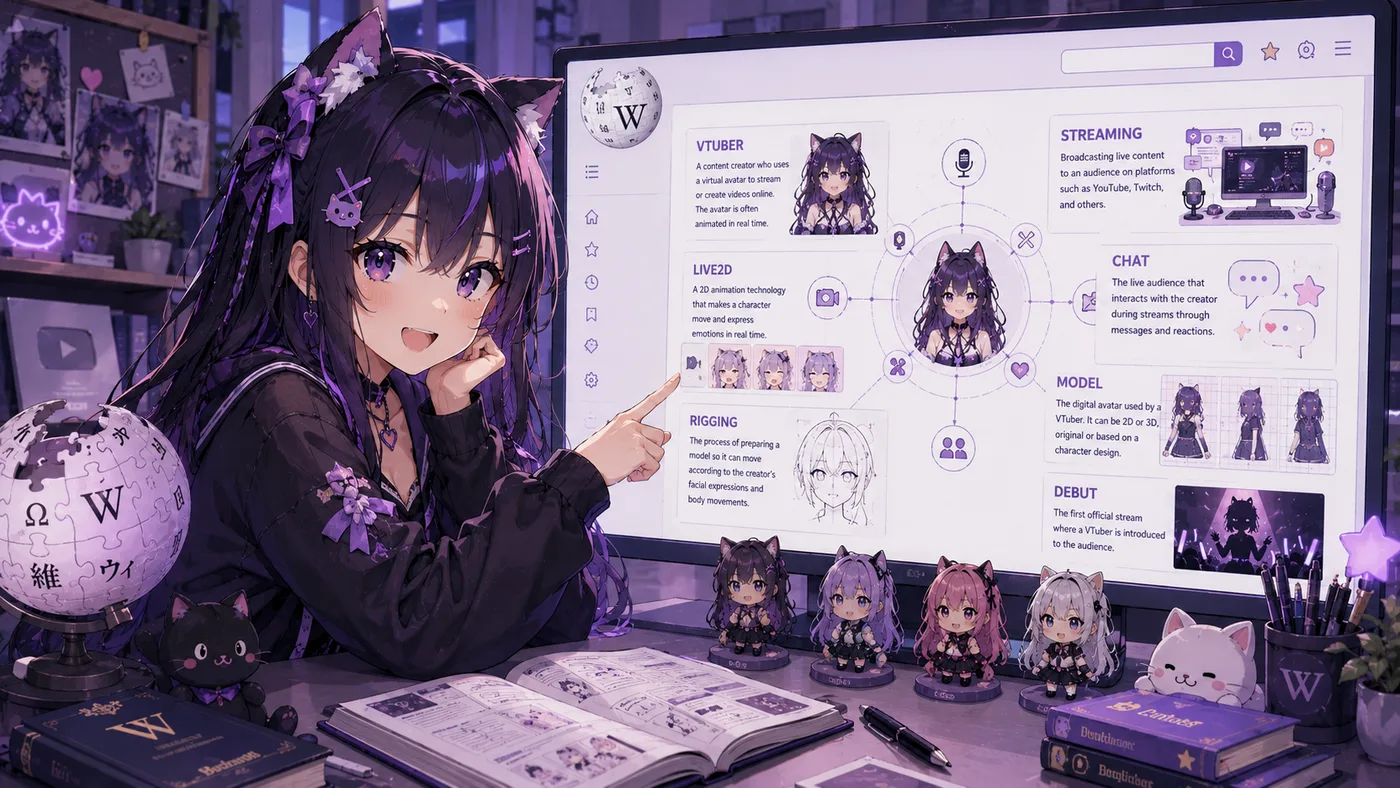
VTuber is shorthand for Virtual YouTuber. In practice it means any creator who performs as a digital avatar animated in real time, whether they upload to YouTube, go live on Twitch, or do both. This wiki explains the word and the vocabulary around it so you can read chats, artist briefs, and debut posts without getting lost.
For a full explainer, read what a VTuber is. For a practical path into the hobby, use how to become a VTuber.
This VTuber Wikipedia is BeTuber’s long-form glossary for the format: what a VTuber / Virtual YouTuber is, how that role sits next to YouTubers, TikTokers, streamers, and influencers, and the tech and culture words that show up in chats, contracts, and artist briefs.
It is notWikipedia.org. It is a reference page built for people who land on “VTuber Wikipedia,” “Virtual YouTuber wiki,” or “VTuber meaning encyclopedia” and want one place that connects the ecosystem. For a shorter core glossary, use the term wiki. For the craft, read what VTubing is. For the person-focused explainer, see what is a VTuber.
VTuber: definition and origin
A VTuber is an online personality who uses an animated avatar as their public face. The avatar is usually anime-inspired, but it can also be a mascot, a semi-realistic figure, or a simple PNG. Motion-capture or face-tracking software copies the performer's expression onto the model while they talk.
The label comes from Japan in the mid-2010s. Virtual idols already existed; what made "Virtual YouTuber" stick was live, chat-facing performance. After early breakout talents, agencies industrialized the format and the word spread into English, Spanish, and other scenes.
Today the "YouTuber" part is historical. Plenty of VTubers are Twitch-first. The avatar-plus-live-performance idea is the definition that still holds.
Live2D
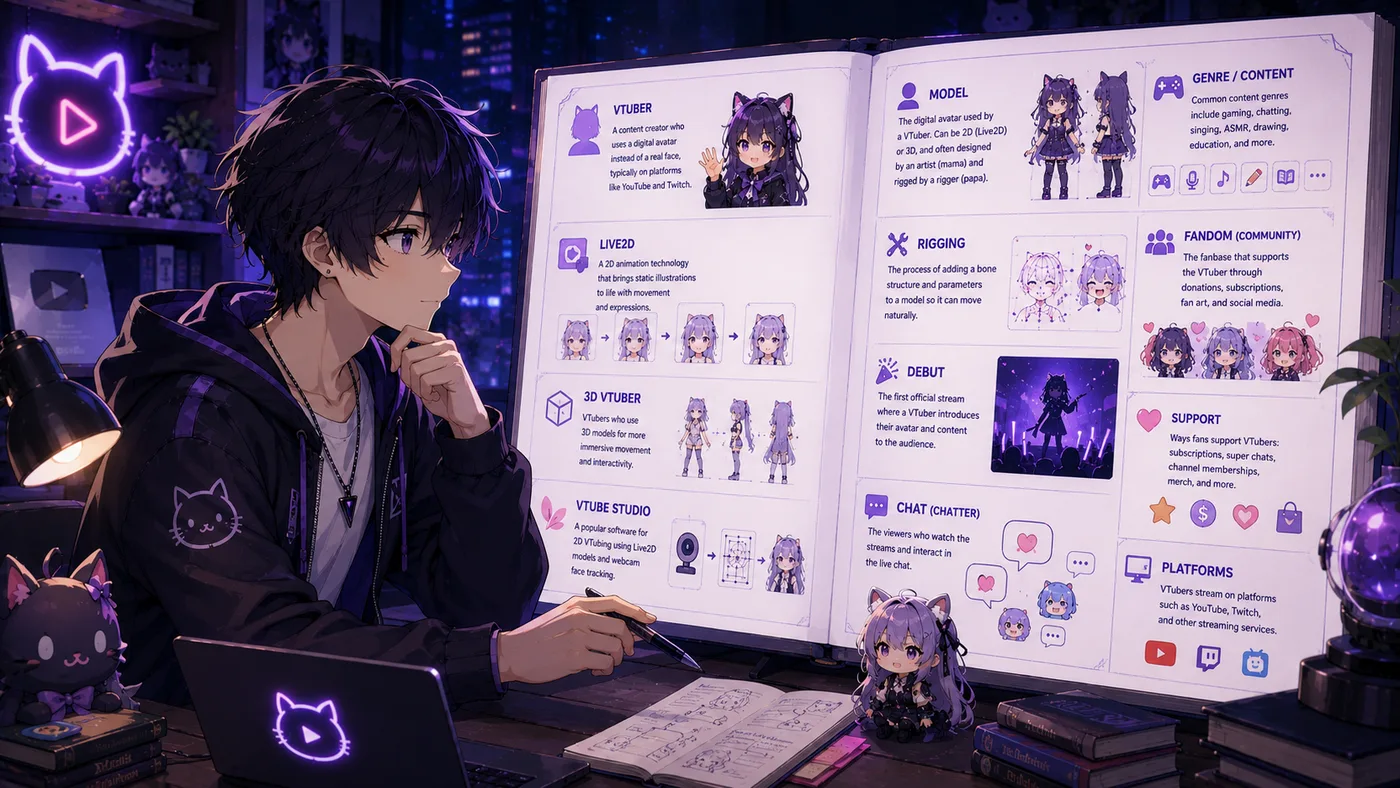
Live2D is the 2D animation system most associated with VTubers. An illustrator draws the character in layers (hair, brows, eyes, mouth, body, clothes). A rigger then wires those layers to tracking inputs so the character can tilt, blink, and lip-sync without becoming a 3D mesh.
People say "Live2D model" the way they say "PNG file": it is both a file format family (often .json plus textures inside a folder or a .vtube.json setup) and a whole profession. Commission prices usually split art and rig.
3D VTubers
A 3D VTuber uses a three-dimensional character, closer to a game avatar. With a VR headset, full-body trackers, or a good IK setup, the talent can walk, dance, and share a 3D space with other models.
3D is heavier on the computer and usually more expensive to commission, but it is the standard for many concerts, 3D collabs, and "room" streams. Some talents keep a Live2D model for chatting and a 3D model for specials.
Tracking and motion capture
Tracking is how the computer knows what your face and body are doing. A webcam can follow the head and mouth. An iPhone can use ARKit for more stable face data. Full-body motion capture uses VR or dedicated suits/trackers.
Motion capture (mocap) is the broader term. In VTuber chat, "my tracking is cooked" usually means the face capture is lagging, jittering, or lost the mouth shapes.
Rigging
Rigging is the invisible skeleton of a model. The rigger decides how far the head turns, how the hair sways, which mouth shapes exist (visemes), and which hotkeys trigger jumps, tears, or a "dead" expression.
A beautiful illustration with a poor rig feels stiff. A simpler drawing with a good rig often looks more "alive" on stream. When you commission, you are buying both.
PNGTuber
A PNGTuber (or PNGtuber) uses one or more still images instead of a full Live2D/3D rig. Software can swap to an open-mouth image when the mic hears speech, or the creator hits a key.
PNGTubers are VTubers. The format is popular for tests, budget debuts, and joke alts. Many people debut as a PNGTuber while waiting on a Live2D queue.
VTuber agencies
An agency is a company that contracts VTuber talents, similar to a talent agency plus a production studio. The two names you will see most often:
- Hololive — Cover Corporation. Generations of talents, large 3D lives, and a very visible English branch (Hololive EN).
- Nijisanji — AnyColor. A wide roster, including English-speaking livers, with a strong variety-stream culture.
Other agencies and collectives exist in Japan, China, Korea, and the West. They differ on IP ownership, clip rules, and how much of the model the talent keeps if they leave. Always read the contract; the Twitter drama is not the documentation.
Indie means not signed. Indies still collab with agency talents sometimes; the word describes the business relationship, not the quality of the model.
Community words you will see in chat
- Oshi: the talent you support most. Oshi mark: the emoji or kaomoji that represents them in chat.
- Debut: the first official stream or video as that character. Redebut / 2.0: a new model or a return after a rebrand.
- Lore: the character's backstory, canon, and running fiction.
- Clipper: someone who cuts stream highlights. Clip culture is how many VTubers get discovered.
- Anti: a hostile account. Not the same as criticism.
- Graduate / graduation: an agency talent's farewell; they leave the company, and the character often retires with them.
- Liver: used especially in Nijisanji spaces as another word for the VTuber talent.
- Rig / model dump / VTS: shop talk for files and VTube Studio.
These words show up in memberships, Discord, and fan art tags. You do not need them to enjoy a stream. You need them to understand why chat is spamming a particular emoji.
Tools, in one list
- VTube Studio (VTS): popular Live2D tracking and hotkey app
- OBS Studio: mixes avatar, game, and alerts for the broadcast
- PRISM Live Studio: all-in-one streaming app some VTubers prefer
- VSeeFace / Warudo: common 3D avatar apps
- Live2D Cubism: the editor side of making a Live2D model
- Blender: frequent choice for 3D modeling
Software changes; the pipeline does not: art → rig → track → encode → platform.
If a term is missing here, it is probably either brand-new slang or a proper noun (a specific talent or software version). The stable core is still the same: a virtual YouTuber is a person, a model, and a live performance glued together by tracking.
Next reads: what is a VTuber, how to become a VTuber, and the software guide.
How to use this VTuber Wikipedia
Skim the creator types section if you are comparing careers. Use tech terms before you buy software. Use culture and agency words when chat or Twitter feels like another language. Internal links jump to deeper guides when a topic needs a full article.
Creator types: VTuber and the neighbors
VTuber
A VTuber (Virtual YouTuber) performs as a real-time animated avatar—usually Live2D or 3D—tracked from a face or body. The avatar is the public identity. Full definition: what is a VTuber. Directory of examples: VTuber models.
Virtual YouTuber
Virtual YouTuber is the long form of VTuber. Historically tied to YouTube in Japan; today it includes Twitch-first and multi-platform talents. Same craft, fuller phrase for encyclopedic and SEO contexts.
VTubing
VTubing is the activity (verb/noun for the practice). You do VTubing; you are a VTuber. Guide: what is VTubing.
YouTuber
A YouTuber uploads or streams on YouTube as their main stage. A VTuber can be a YouTuber when the home platform is YouTube. A facecam gaming YouTuber is not a VTuber unless they use a live avatar as the face.
Streamer
A streamer goes live on Twitch, YouTube Live, Kick, or similar. Most VTubers are streamers. “Streamer” says nothing about whether the face is human, PNG, Live2D, or 3D.
TikToker
A TikToker builds audience primarily on TikTok (short vertical video). Many Virtual YouTubers also act as TikTokers by posting clips of the same avatar. TikToker = distribution surface; VTuber = performance format.
Influencer
An influencer monetizes attention through brand deals, affiliate links, and audience trust—on any platform. Agency and indie VTubers can be influencers when they sell sponsorships or merch. Influencer is a business role, not a model type.
Content creator
Content creator is the umbrella: YouTubers, TikTokers, streamers, podcasters, VTubers. Useful in contracts and media; too vague for software shopping.
PNGTuber
A PNGTuber is a VTuber who uses swapped still images instead of a full Live2D/3D rig. Still counts as Virtual YouTubing. See the term wiki.
AI VTuber / AI-fronted avatar
An AI-fronted channel uses generated speech or chat with an anime-style face. Related to, but not identical with, human VTubing. Deep dive: VTubers and AI.
Liver
Liver is often used (especially in Nijisanji spaces) as another word for the VTuber talent on stream.
VTuber vs YouTuber vs TikToker vs influencer
| Label | What it answers | Overlap with VTubers |
|---|---|---|
| VTuber / Virtual YouTuber | How you appear (live avatar) | Core identity |
| YouTuber | Main platform is YouTube | Common, not required |
| Streamer | You go live | Almost always true for VTubers |
| TikToker | Growth via short vertical video | Optional clip strategy |
| Influencer | You monetize attention with brands | Optional business layer |
A single person can be all five in one week: Live2D stream on Twitch (VTuber + streamer), VOD on YouTube (YouTuber), clip on TikTok (TikToker), sponsored merch read (influencer). This Wikipedia page keeps the avatar format as the VTuber-specific piece.
Technology terms
Live2D
Layered 2D illustration on a rig. Default chatting look for indie Virtual YouTubers. Editor: Cubism. Runtime apps: VTube Studio / PRISM. Details: VTuber app guide, software guide.
3D model / VRM
Mesh-based avatar for room streams, dance, VR. Apps: VSeeFace, Warudo, and similar.
Rig / rigger
The wiring that makes art move. Visemes, physics, hotkeys. Commission art and rig as separate line items when you can.
Tracking / mocap
How the computer reads face or body. Webcam, phone ARKit, VR full-body. “Tracking is cooked” = capture failed or jittered.
Viseme
Mouth shape tied to speech sounds. Bad visemes make lip-sync look wrong even when tracking is fine.
Hotkey / expression toggle
Keyboard shortcuts that jump, cry, blush, or swap outfits live—core of many VTuber apps.
OBS / encoder
Broadcast mixer that sends the show to the platform. Not an avatar maker.
Model license / commercial use
Legal right to monetize streams and merch with that file. Directory context: VTuber models.
Platform terms
Twitch
Live-chat culture, categories, subs/bits. Home for many Western indie VTubers.
YouTube
VODs, memberships, Shorts, discovery via recommend. Historical home of the “Virtual YouTuber” label.
TikTok / Shorts / Reels
Clip layer. Turns a three-hour stream into a thirty-second introduction to the character.
Bilibili / TwitCasting
Major stages for Chinese virtual creators and Japanese live culture respectively.
Discord / membership
Community layer around the Virtual YouTuber brand—emotes, lore, schedule posts.
Agency and career terms
Agency
Company that contracts talents, often supplies model IP, managers, and debut push. Hololive (Cover) and Nijisanji (AnyColor) are the names outsiders know first. Trade-offs: agencies vs indie.
Indie
Not signed. You commission or buy the model and own (or should own) streaming rights.
Debut / redebut / 2.0
First official stream as that character; later model upgrades or returns.
Graduation
Agency farewell; the character often retires with the contract. Directory statuses mark graduated talents for that reason.
Gen / generation / wave
Agency cohort branding (EN gen names, numbered waves). Indies usually have no gen.
IP (intellectual property)
Who owns the character design and name. The quiet core of agency vs indie drama.
Culture and fan terms
Oshi / oshi mark
Your favorite talent; the emoji/kaomoji fans spam in chat.
Lore
Character canon and running fiction. Keep it light at debut; expand later.
Clipper
Editor who cuts highlights. Clip culture is discovery infrastructure for Virtual YouTubers—same economy TikTokers and Shorts creators live in.
Anti
Hostile account. Distinct from normal criticism.
Collab
Shared stream between talents. Distribution tool as much as social event.
Merch / plush / acrylic
Physical products of the avatar brand—where VTuber, influencer, and IP law meet.
Fanart / fanfic tags
Community creative layer; often has official hashtag rules from agencies.
Business and marketing terms (influencer-adjacent)
Brand deal / sponsorship
Paid integration. Common once a Virtual YouTuber has stable average viewers or clip reach.
Affiliate / creator code
Revenue share links—same toolkit as YouTubers and TikTokers.
Parasocial
One-sided audience relationship. Stronger when the avatar feels consistent; not unique to VTubers but very visible in the format.
Personal brand vs character brand
Facecam influencers sell the person. VTubers sell the character first. Face reveals change that balance on purpose.
Related topics outside pure VTubing
Virtual idol / CG idol
Pre-rendered or heavily produced virtual performers. Overlaps history with VTubers; less always-on live chat. Kizuna AI–era Virtual YouTubers bridged idol aesthetics and YouTuber habits.
Furry / kemono streamers with avatars
Often use the same tracking apps. Whether they use the VTuber label is community preference; the tech stack can be identical.
Metaverse / VRChat avatars
3D social worlds. Some VTubers cross over; VRChat avatar ≠ automatic VTuber channel unless they also publish as a Virtual YouTuber persona.
Face cam / IRL streamers
Human-face streamers. Opposite presentation of VTubing; same platform skills (schedule, chat, clips).
Compact glossary A–Z (quick scan)
- Agency — company contracting VTuber talent
- Clipper — highlight editor
- Cubism — Live2D model editor (not the live app)
- Debut — first official stream as the character
- Graduation — agency exit / character retirement
- Hotkey — live expression trigger
- Indie — unsigned Virtual YouTuber
- Influencer — monetizes attention with brands
- Live2D — layered 2D avatar system
- Liver — talent on stream (esp. Nijisanji usage)
- Lore — character story
- Model — the avatar file
- OBS — broadcast mixer
- Oshi — favorite talent
- PNGTuber — still-image VTuber
- Rig — animation wiring
- Streamer — anyone who goes live
- TikToker — short-video-first creator
- Tracking — face/body capture
- Virtual YouTuber — full form of VTuber
- VRM — common 3D avatar format
- VSeeFace / VTube Studio — popular tracking apps
- VTubing — the practice
- YouTuber — YouTube-first creator
What to read after this VTuber Wikipedia
- Role: what is a VTuber
- Craft: what is VTubing
- Short glossary: what VTuber means (wiki)
- Downloads: VTuber app · best VTuber software
- Career: how to become a VTuber · agencies vs indie
- People: VTuber models directory
VTubers sit inside a wider creator economy of YouTubers, TikTokers, streamers, and influencers. This Wikipedia-style page keeps the avatar + live performance definition sharp so those neighboring labels stay useful instead of interchangeable mush.