
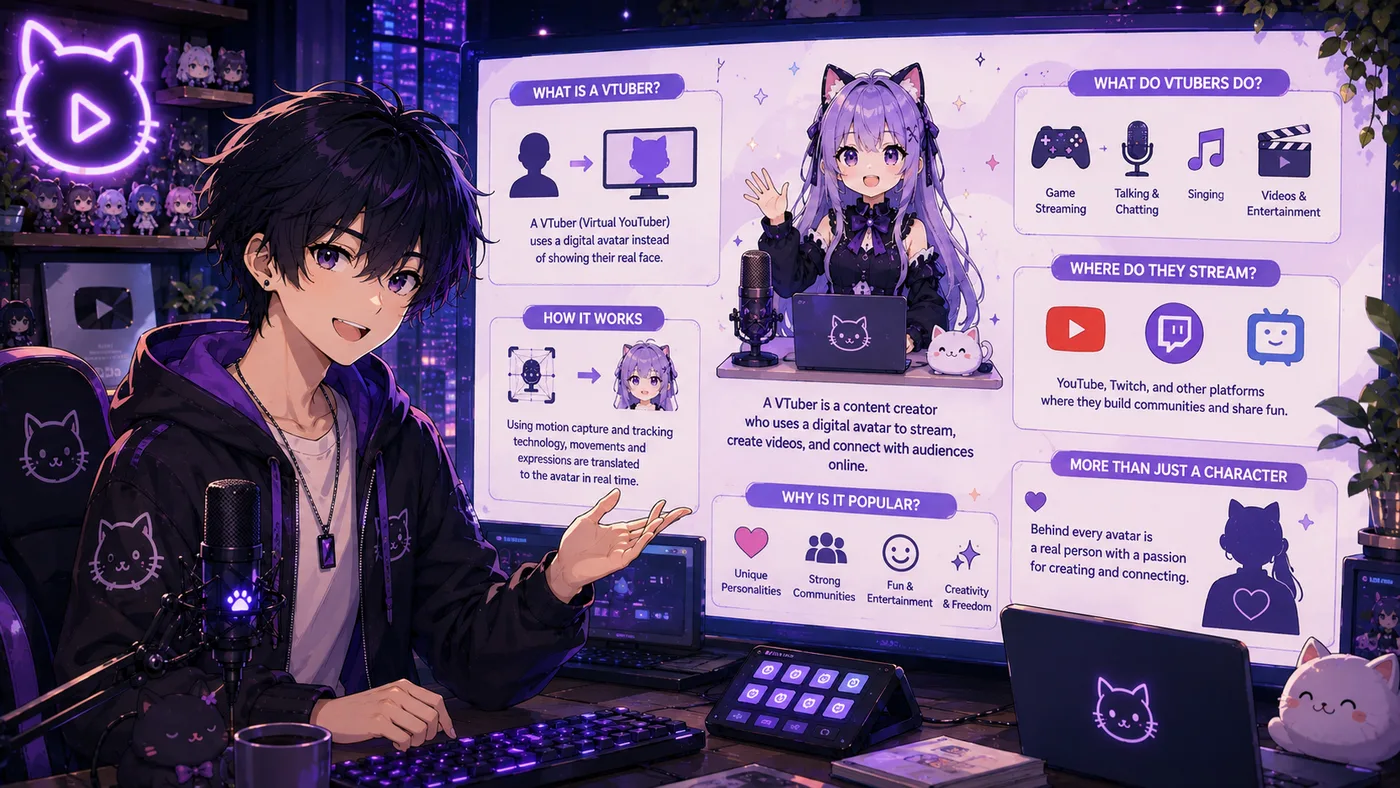
A VTuber (short for Virtual YouTuber) is an online creator who appears as an animated digital avatar instead of a webcam of their real face. Using motion tracking and facial recognition, the avatar copies the performer’s expressions and movements in real time, so they can stream games, chat, sing, or host events as if they were a living anime character.
VTubing is the craft: going live (or publishing videos) as that moving avatar. If “what is a VTuber?” names the person, “what is VTubing?” names the practice—tracking, character, chat, and schedule working together.
The format started in Japan and spread worldwide because it combines three things audiences already love: streaming, character-driven stories, and the visual language of anime and games. If you want the glossary behind the culture, see our wiki of VTuber terms. If you want to debut yourself, read the guide on how to become a VTuber. For the apps, see VTuber software. To look up individual talents, open the free VTuber models guide.
VTubing, VTuber, and Virtual YouTuber
These three phrases get mixed online. Keep them straight and your SEO and your own brand both get clearer.
| Term | What it points to |
|---|---|
| VTubing | The activity: streaming or uploading as a live avatar |
| VTuber | The creator / persona who does that activity |
| Virtual YouTuber | The full English phrase the format grew from (especially after mid-2010s Japan) |
You do VTubing. You are a VTuber. You are a Virtual YouTuber in the historical sense even if your main platform is Twitch rather than YouTube. Agency marketing, indie bios, and clip titles often use all three interchangeably; for learning, treating VTubing as the verb keeps the craft focused.
How VTubers work
A VTuber setup has two layers: the character the audience sees, and the performer who controls it. The performer talks into a microphone, looks at a camera or phone, and often uses a keyboard, gamepad, or hotkeys. Tracking software reads the face (and sometimes the body), then the avatar software applies those movements to a 2D or 3D model.
That is why a good VTuber stream feels alive. Blinks, smiles, head tilts, and hand toggles happen as the person reacts, not as a pre-rendered cartoon.
Every VTubing stack has the same layers, whether you are beginner or advanced:
- Persona — name, voice, vibe, and what a normal stream is about
- Model — PNG frames, Live2D, or 3D (often VRM)
- Tracking — webcam, phone, or full-body gear driving the model
- Broadcast — OBS (or similar) compositing avatar + game + alerts
- Platform — Twitch, YouTube, Bilibili, TwitCasting, and clip apps off-stream
Mixing those layers is how beginners buy Cubism when they needed a finished avatar, or install a 3D app for a Live2D file. Match the file type to the tracker. Details live in the software guide; free starting models are covered in free VTuber models.
Live2D and 3D avatars
Most VTubers use one of two model types:
- Live2D starts as a layered illustration. Artists separate hair, bangs, eyes, mouth, and clothes so the software can move each piece. It is the look most people associate with VTubers: a 2D character that still turns, breathes, and emotes.
- 3D models are built like game characters. They can walk around a virtual space, use full-body tracking, and appear in concerts or 3D collabs with less visual compromise.
Neither is “more real.” Live2D is cheaper to start with and reads clearly on a facecam-style crop. 3D shines when the stream is about movement, dancing, or sharing a 3D world with other talents.
Tracking, rigging, and software
Rigging is the work that makes a drawing or model actually move. A rigger maps tracking inputs (eye open/close, mouth shapes, head XYZ rotation) onto the art. Tracking is the live capture: a webcam, an iPhone with ARKit, or a full-body system such as a VR headset and trackers.
Common tools include VTube Studio and PRISM Live Studio for Live2D, and VSeeFace or Warudo for many 3D setups. OBS Studio (or a similar encoder) is still the usual way to send the avatar, game, and alerts to YouTube or Twitch. Side-by-side tool matchups live under Compare.
A short history of VTubers
Virtual idols existed before the word VTuber. What changed in the mid-2010s was live interaction. Instead of a fully produced CG character that only appeared in videos, creators could sit down, go live, and let the avatar react to chat in the moment.
Kizuna AI, who debuted in 2016, is the name most histories use as the spark for the modern boom. She published videos as a “virtual YouTuber,” and the label stuck. Japanese agencies then professionalized the model: Hololive (Cover Corporation) and Nijisanji (AnyColor) recruited talents, built lore, and turned collabs, merch, and 3D live shows into a full entertainment pipeline.
English-speaking and Spanish-speaking scenes followed, both through agencies and through a large indie wave. Today “VTuber” covers everything from a student with a PNG avatar on Twitch to a corporate talent selling out concerts.
Independent VTubers vs agencies
Indie VTubers own their character, schedule, and brand. They pay for their own model, handle thumbnails, and grow through clips, community, and consistency. The upside is control. The downside is doing every job at once. That path is now the default; see agencies vs indie.
Agency VTubers join a company that may provide a model, manager, clip rules, and a built-in audience of fans who already follow the brand. In exchange, the talent follows guidelines, shares revenue, and represents the company in public.
Neither path is required to “count” as a VTuber. The audience mostly cares that the character feels consistent and the streams are worth returning to.
Why VTubers became so popular
VTubers lower the social cost of going live. A performer can protect their privacy, play with a voice and aesthetic, and still build a parasocial relationship that feels personal. For viewers, the avatar is easier to clip, meme, and emotionally invest in than a random webcam.
The format also rewards character. Lore, catchphrases, oshi marks, and running jokes travel well on short video. A two-minute clip of a VTuber panicking at a jumpscare can introduce the character to people who would never sit through a six-hour stream.
There is a practical reason too: the same tracking stack works for chatting, karaoke, reacting, and gaming, so creators can change content without changing identity.
VTubers vs traditional streamers
A traditional streamer is usually the person on camera. A VTuber is a persona first. The voice may be close to the performer’s real voice or stylized; the face is almost always the model.
In every other way they do the same job. They talk to chat, run donations and memberships, collaborate, burn out, take breaks, and build a catalog. The technology is a presentation layer, not a different career.
If you already stream with a facecam, becoming a VTuber is less “invent a new job” and more “change how you appear while you keep making content.”
Beginner VTubing: your first Virtual YouTuber stream
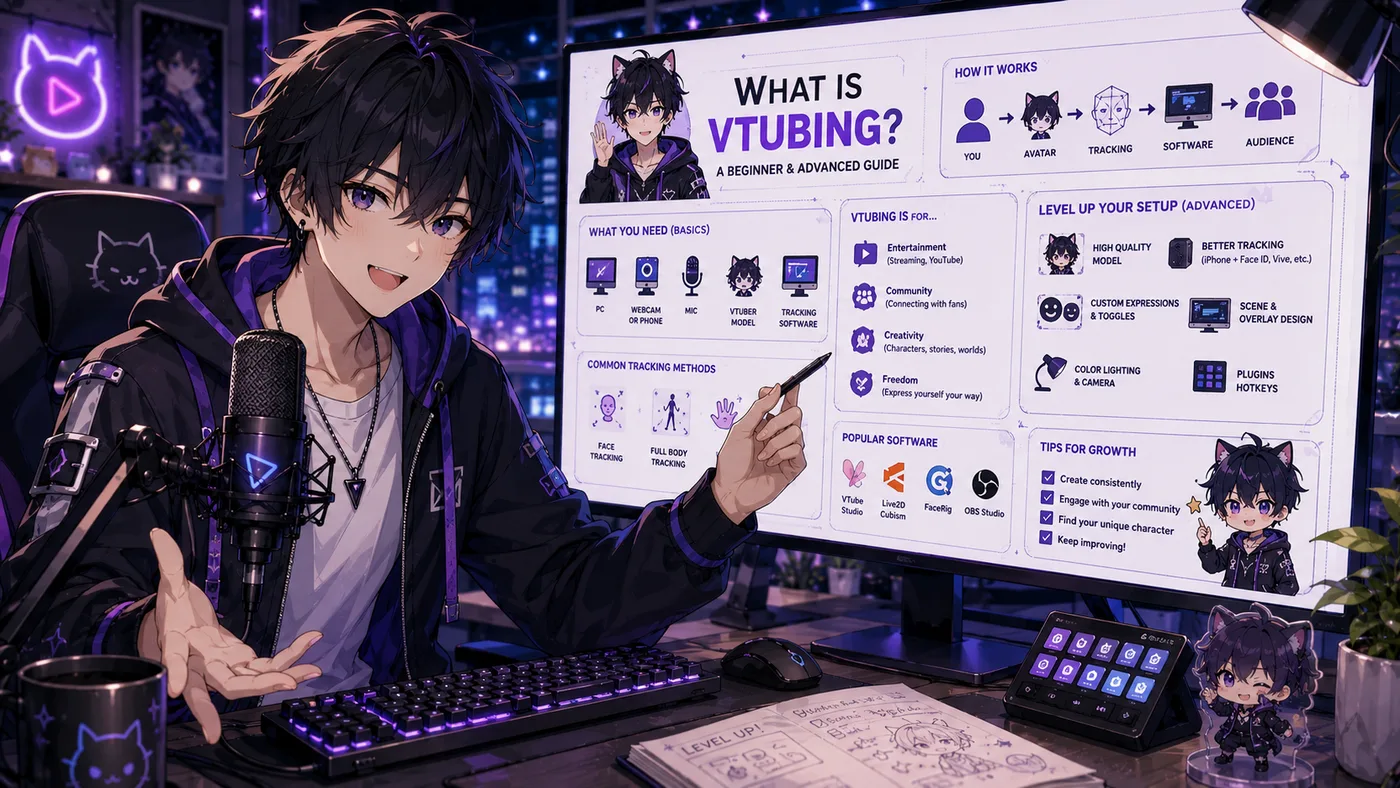
Beginner VTubing has one job: get a readable avatar on a stable stream and talk. Everything else can wait.
Pick a persona you can sustain
Write one sentence: who you are on stream and what you do on a normal day. A horror-only shark, a chill Just Chatting fox, and a ranked FPS demon need different models and thumbnails. Lore can stay short. Voice consistency matters more than a novel-length backstory.
Start with the cheapest model that feels like you
- PNGTuber — still images that swap when you talk. Fastest path into VTubing.
- Premade Live2D — faster than a custom commission; less unique.
- Custom Live2D — the default indie Virtual YouTuber look; budget art and rig separately.
Demand a commercial-use license in writing if you buy or commission. You will need it for monetization and merch later. Legal free starting points are listed in free VTuber models.
Audio before cosmetics
Chat forgives a simple model. Chat leaves for bad mic noise. Get a clear microphone, light your face enough for tracking, and test OBS before debut day. A weekend PNG debut beats a six-month wait with no practice streams.
Debut without an agency
Most people start VTubing as indie. You do not need a company to be a real Virtual YouTuber. Agencies are optional leverage later; see agencies vs indie. Step-by-step debut logistics are in how to become a VTuber.
Intermediate VTubing: looking like a channel
Once you can go live without panic, VTubing becomes product design.
Readable Live2D and layout
Upgrade the model when the PNG silhouette starts holding you back, not because Twitter said so. Keep facecam crop readable: clear silhouette, limited palette, one or two signature details. Build a layout chat can parse: avatar, game or cam focus, alerts that do not bury speech. Overlays and scene structure are covered in VTuber overlays and VTuber scenes.
Schedule and clip loop
VTubing grows off-stream as much as on-stream. Short clips on YouTube Shorts, TikTok, and X introduce the Virtual YouTuber to people who will never sit a six-hour raid. Pick a schedule you can keep. A consistent “Tue/Thu Just Chatting” beats random twelve-hour marathons that burn you out.
Community without leaking the performer
Discord, memberships, and emotes belong to the character. Keep personal data off-stream unless you choose a reveal. Privacy is a feature of VTubing, not a bug. Face-reveal tradeoffs are covered in VTuber face reveal.
Advanced VTubing: production and career level
Advanced VTubing is still the same craft—avatar, voice, chat—with higher production and clearer business rules.
3D, full-body, and show streams
3D models and full-body tracking unlock dancing, VR rooms, and concert-style shows. They cost more PC power and money. Many agency Virtual YouTubers keep a Live2D chatting model and a separate 3D concert file. Do not assume one purchase covers both.
Brand, merch, and IP
Know who owns the model. Indie VTubing usually means you (should) own commercial rights. Agency VTubing often means company IP and graduation rules. Mixing those without reading the contract is how creators lose a character they built in public.
Collabs, multilingual reach, and burnout control
Advanced creators treat collabs as distribution, not only friendship. Multilingual streams or bilingual chat expand the Virtual YouTuber audience—BeTuber’s directory includes Spanish-speaking history for that reason. Protect sleep and voice; advanced gear cannot fix a ruined schedule.
Monetization that matches the persona
Subs, bits, memberships, merch, and sponsorships all work for VTubing when they fit the character. Hard-sell that breaks the persona trains chat to mute you. Soft CTAs tied to lore or running jokes usually age better.
Where VTubers stream and grow
Live platforms still matter most. YouTube is strong for VODs, memberships, and discovery through recommended videos. Twitch is strong for live chat culture and categories. Many Japanese talents also use TwitCasting; many Chinese virtual creators use Bilibili.
Growth often happens off-stream: clips on YouTube Shorts, TikTok, and X, plus a Discord or membership community. That is why a VTuber with a modest live audience can still feel huge if their clips travel.
Discovery still loves a clear name, a consistent avatar crop in thumbnails, and titles that say what the stream is—not only “VTubing live.”
Common VTubing mistakes
- Buying Cubism or a 3D suite before you have a finished, licensed model to load
- Debuting on a first-ever OBS layout with no audio test
- Copying another VTuber’s model or silhouette (legal and career dead end)
- Waiting for an agency instead of shipping an indie Virtual YouTuber channel
- Treating AI chatbots as a drop-in replacement for live VTubing without understanding the trade-offs—see VTubers and AI
Beginner vs advanced VTubing checklist
Beginner
- Persona one-liner and voice you can hold for two hours
- PNG or simple Live2D with commercial rights
- Tracking + OBS path that actually exports to Twitch or YouTube
- Soft debut or unlisted practice before the “real” day
Advanced
- Model upgrade path (Live2D and/or 3D) documented with licenses
- Clip pipeline and a schedule you keep
- Clear indie vs agency IP decision
- Monetization and collab rules that match the Virtual YouTuber brand
- Health boundaries so VTubing stays sustainable
The future of VTubers
Better webcams, phones, and 3D tools keep lowering the floor. A first avatar no longer has to cost thousands of dollars. At the same time, the ceiling keeps rising: concerts in virtual venues, branded collabs, and multi-language generations from the big agencies.
AI will keep showing up around the edges (chat helpers, clip editing, experimental avatars), but the core of the scene is still a person performing live. Viewers can tell when nobody is home. For the AI pillar, see VTuber AI.
VTubers are not a fad layered on top of streaming. They are a way of doing streaming that treats the character as the product. VTubing is not a different career from streaming—it is streaming with a Virtual YouTuber face as the product. Beginners prove they can show up. Advanced creators prove they can keep the character, the tech, and the business in the same room without burning out.
If you are still mapping the vocabulary, open the VTuber wiki. If you are ready to build a model and debut, start with how to become a VTuber.