Searches for how to make a VTuber model with Claude usually mean one thing: you want a character brief that does not sound like a wiki dump, and you want that brief to become a face. Claude is strong at structured notes—tables, constraints, “here is what to cut.” It will not hand you a Live2D package. Anyone promising that is selling a different product under this keyword.
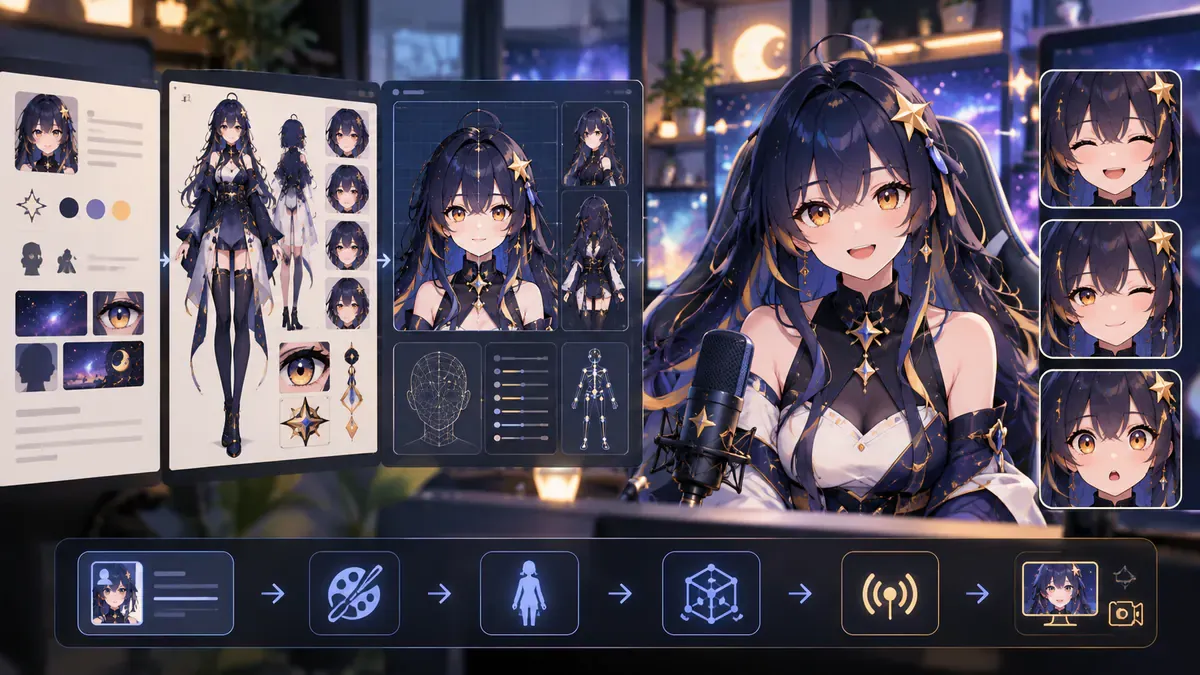
The honest workflow is split. Claude pens the design system. A studio turns it into a VTuber model you can move. BeTuber sits in that second job: generate the look, add expressions, practice tracking, then go live when you are ready. If you are still mapping the wider debut, start with how to become a VTuber; this article is the Claude-shaped on-ramp into the same path.
You do not need a perfect novel of lore. You need a silhouette chat can remember and a personality that survives a three-hour Just Chatting. Claude helps you say that cleanly. BeTuber is what gets you out of the notes app and into a face that moves.
Generate a VTuber model in Claude with BeTuber
Start a Claude project (or a long chat) and ask for a stream brief: one-sentence brand, silhouette, three-color palette, two props, three live personality rules, and a hard “no agency clones” line. Feed that brief into BeTuber at app.betuber.com and generate the character. Claude stays your editor for the next revision—“same fox pin, warmer jacket, bangs that read at 720p”—while BeTuber regenerates the actual avatar.
That is the real move when you make a VTuber model with Claude: keep the language model on words, keep the studio on pixels that can move. Two careful paragraphs in Claude beat ten rambly ones. Two generates in BeTuber beat twenty orphan PNGs in a folder named final_final.
Where Claude earns its seat at the desk
Claude is especially useful when you want:
- Constraint lists that stop design drift
- Lore that fits in a Discord about section
- Before/after rewrites of a muddy visual brief
- Expression menus mapped to personality (“smug only after a win”)
- Debut night checklists that do not bury the mic setup
It is less useful as a fake rigger. Parameters, physics, and tracking live elsewhere—see VTuber rigging and the software guide. If you are hunting premade files, read free VTuber models so a “free download” does not become a copyright problem on day one.
A Claude brief template that ships
Paste something close to this, then edit the brackets:
Design a debut VTuber for a [game/chat] channel. Give me: (1) one-sentence brand, (2) silhouette + three colors + two props, (3) three personality rules for live chat, (4) five expression names, (5) an 80-word generation brief for an avatar studio. Reject Hololive/Nijisanji lookalikes. Optimize for readability at facecam size.
Take output (5) into BeTuber. After the first generate, paste a screenshot description back to Claude and ask for a delta brief only. Professionals revise; they do not restart the universe every time a sleeve looks wrong.
From Claude notes to a live avatar
A VTuber model is the thing that moves when you talk. Claude can invent the character; BeTuber is built to create the portrait, expressions, and scenes, then let you practice before debut. That matches the product loop on the marketing site: create, perform, launch—not “export a mystery zip and figure OBS out alone at 2 a.m.”
When money shows up later, your Claude project becomes the commission packet for a human illustrator and rigger. You are buying polish on a character the audience already met, not gambling on a first design you never streamed. For the AI-ethics side of generated performers, keep VTubers and AI nearby so you do not confuse a helpful assistant with an unsupervised AI streamer.
Mistakes Claude will not catch for you
- Lookalike silhouettes dressed up as “inspired by”
- Too much lore, not enough face
- Outfit spam before the face is locked
- Calling a still image a finished model
- Never practicing tracking with a moving avatar
- Skipping license questions before bits and sponsorships
Claude can warn you if you ask. You still have to ask. And you still have to open a studio.
ChatGPT, image tools, and picking a lane
If your muscle memory is ChatGPT, use the sister guide: how to make a VTuber model with ChatGPT. Midjourney or other image models can moodboard. None of that replaces the handoff into BeTuber when you want a character you can take live without juggling five exports. Pick the assistant you already trust; standardize the studio.
Bottom line
How to make a VTuber model with Claude: lock a short brief in Claude, generate and refine the avatar in BeTuber, then practice until the model follows your face. Claude writes. BeTuber builds. You perform.
Next: open the studio · how to become a VTuber · VTubers and AI · make a model with ChatGPT