
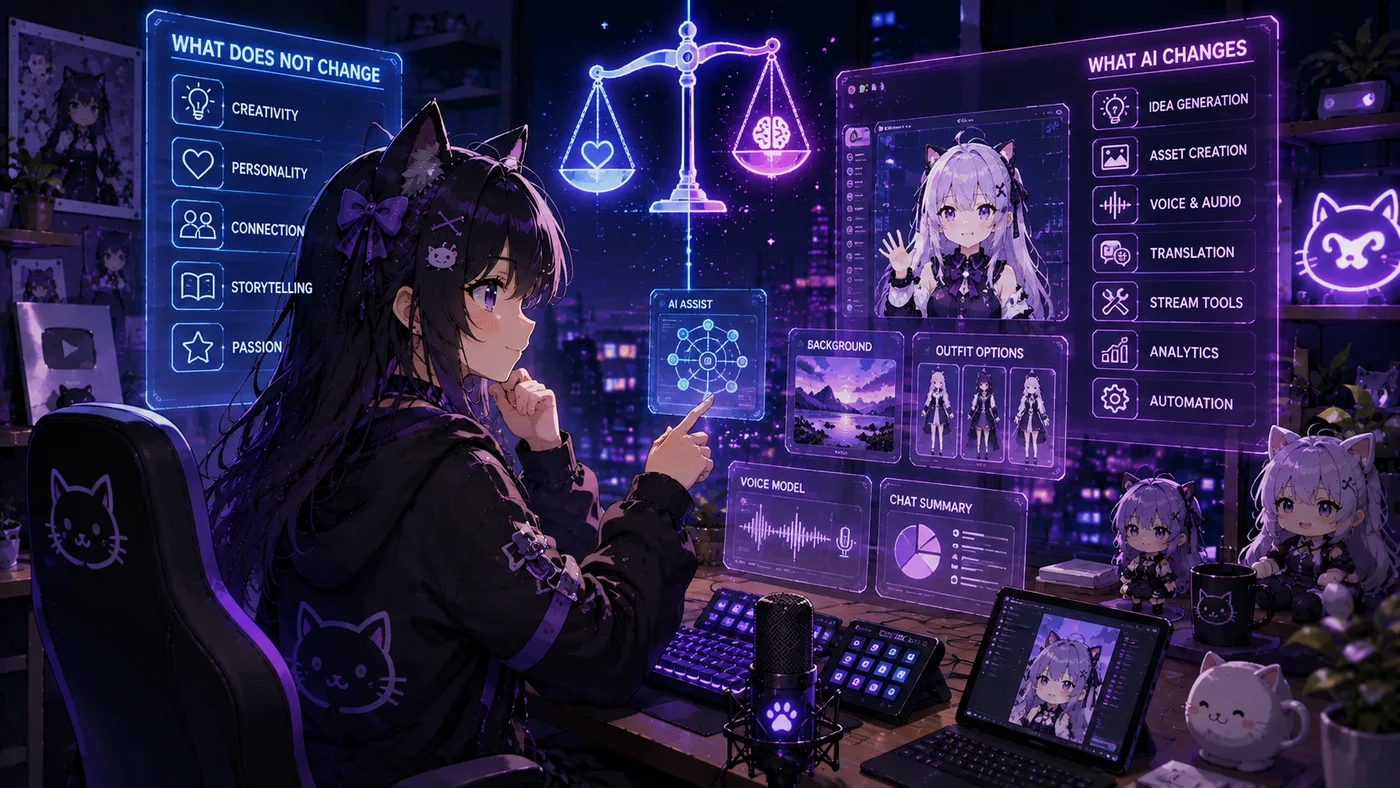
An AI streamer is a live channel whose character speaks because a model is writing the lines. There is a voice, an avatar, and, almost always, someone in the production with the authority to cut the broadcast. That person disappears on screen. You see a name, a face, and a temperament. The account does not lose them. A ban, a copyright claim, and the platform’s email still arrive at a human being.
AI streaming is a wider label. It includes that kind of show, and it also includes the ordinary tools a person uses around their own broadcast: a transcript of the VOD, a suggested clip, a filter on a raid, a translated title. The two are sold together. They are not the same labor. In one, the model carries the performance. In the other, someone is still performing, and the software is saving them tasks.
A debut with your own voice is covered in how to become a VTuber. The question of tools versus an AI-fronted talent is in VTubers and AI. What follows is the live format itself.
What you see when the channel opens
Ten minutes in, the useful question is whether anyone is directing.
On a broadcast that works, chat is part of the scene. The character can return to a thread, abandon a joke that died, and recognize, even roughly, someone who has been in the room for a while. On a weak one, every message receives a polite answer and none of them change what happens next. Viewers feel the difference in a single night. They do not need the architecture explained.
Neuro-sama is the case most people have actually watched. Vedal builds her, repairs her, and stays close enough to intervene. She is an AI VTuber in the sense that matters: a virtual persona, a live audience, and speech that is generated rather than captured from a performer’s face. Watch her the way you would watch any live whose pacing you want to learn. Rebuilding her, voice included, is a different project, and a worse one.
A human VTuber is still a person at a microphone, driving an avatar in VTube Studio or something close to it. What a VTuber is starts there: a character and a room. Face tracking can be simple. Presence is not replaced by a prompt and still the same job.
How the hour stays together
The overlay shows one character. The broadcast is several systems that only look unified because someone keeps them that way.
The character has a name, a temperament, and subjects that stay off limits. A language model proposes the next line from chat and from whatever memory the setup actually keeps. If that memory is cleared every stream, regulars notice on the second visit. The voice is text-to-speech, or a voice the channel has rights to use. A convincing voice on a face you do not own is a consent problem, however clean the demonstration looks. The avatar may be a Live2D file, a 3D model, a PNG, or occasionally a generated image. Audio can move the mouth. The file still has a license, and you should be able to explain it to a collaborator.
Chat arrives with the rest of what chat brings: spam, raids, and people trying to push the model somewhere the channel cannot go. The filter belongs in front of the model, not after the clip has already circulated. Scenes, a break screen, and a control that actually ends the stream live in OBS or another broadcaster. That layer does not vanish because the dialogue is generated. The software guide is still where that choice belongs.
Someone has to watch the output. Showrunner is a workable title. They hold the stream key and decide when the segment ends. A setup sold as autonomous keeps this job if the channel lasts longer than a weekend. An unattended stream is the one nobody is watching, which is when the sentence you cannot walk back goes out live.
Different shows, one name
Several kinds of broadcast get filed under AI streamers. Mixing them up is how people buy the wrong thing.
In some, the microphone belongs to the model. The character’s speech is generated, and chat is the other performer. In others, a person is talking, and a model handles a segment, a side character, or the reading of donations. Those work when the audience knows which voice is software. They sour when a clip travels as if a real guest had joined.
Playing a game and talking about it are two jobs stacked. One system plays, or simulates play. Another comments. Chat will catch an invented rule immediately, because the category already knows the game. Conversation streams depend on a smaller skill: noticing who has been in the room, and not greeting them as new after every raid. A personality that resets can be a joke. Left unexplained, it reads as if nobody stayed.
Long broadcasts, including the ones sold as always on, do not remove the middle of the night. At hour six there is still chat, still a music license, and sometimes someone else’s model in the scene. A quiet room left running is a VOD nobody reviewed. Clips and uploaded videos can send viewers to the live. They are another day’s work. Thirty seconds with no context will be shared by people who believe a person said it.
On a human channel
Most VTubers who use AI are not trying to become this kind of streamer. They want the dull parts finished sooner. A transcript so the community post is accurate. Clip ideas they still approve. A filter. A translation they read before pinning it. A thumbnail sketch they redraw until the character looks like herself.
Tracking remains its own application. A language model will not lip-sync a mesh. An avatar meant to last for years should be commissioned or built under a license that survives a collaboration and a sponsorship. A voice tool you control can cover a spare line or a language test. Cloning another performer’s voice brings a generated character’s problems into a human channel, in front of an audience that came to hear a person.
Agency or independent does not get simpler because a model writes the lines. That choice is still about who owns the character and who does the work.
Twitch, YouTube, and the name on the account
These shows air where other lives air. Twitch, YouTube, and whichever platform is current that month. The category label changes. Delay, scenes, raids, and a chat that clips faster than a sentence can be corrected do not.
Rules on synthetic performers move often. Read the current ones for the site you use, in the week you go live, rather than trusting a guide’s summary. The stream key sits on a human account. So does the suspension, the chargeback, and the mail about a song, a game capture, or a voice that belongs to someone who did not agree. Publishing the broadcast is the act that counts. Blaming the model does not move the account.
Say clearly when the speaking character is generated, whenever a viewer would think a person is performing. Say when a guest is a model. Channels that keep an audience already treat that disclosure as part of the show. People can enjoy the format. They mind being told it was something else.
Do not train on another talent’s VODs, voice, or artwork in order to compete with them. Do not take a Live2D mesh you have no rights to. The test is ordinary: if you would not want it done with your face, do not do it with theirs.
The VTuber version of that standard, and which tools belong beside a debut, is in VTubers and AI. When the vocabulary starts to collide, the wiki is there. If the voice on the channel is yours, you are still the one who has to show up.